
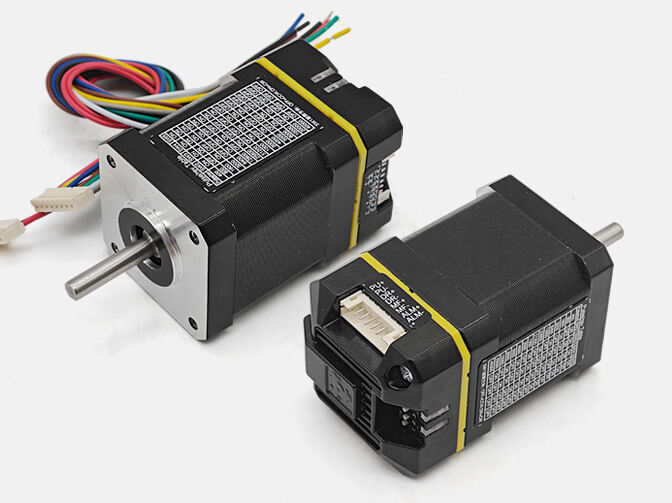
Hybrid servo motors are widely used in industries requiring precise control over position, velocity, and torque. These motors combine the benefits of both stepper and traditional servo motors, offering high torque, smooth motion, and energy efficiency. However, like any complex mechanical system, hybrid servo motors can face issues that hinder their performance. Understanding common problems and their solutions is crucial for ensuring that these motors continue to function efficiently in demanding environments.
Common Issues with Hybrid Servo Motors
-
Erratic or Unstable Motion One of the most common issues with hybrid servo motors is erratic or unstable motion. This can manifest as the motor skipping steps, moving unevenly, or exhibiting jittery movements during operation. It can occur for several reasons, including insufficient current supplied to the motor, improper tuning of the drive controller, or misalignment between the motor and the load.
Solution: First, check if the motor’s drive is providing adequate current for the application. If the motor is underpowered, increase the current or choose a motor with a higher power rating. Ensure that the drive settings are optimized for the specific motor, and recalibrate if necessary. It’s also important to check the mechanical alignment and ensure that the motor and load are properly coupled.
-
Overheating Overheating is a serious issue that can lead to permanent damage to the motor and associated components. Stepper Motor & Drivers s can overheat if they are run at too high a speed or load for prolonged periods, or if there is insufficient cooling in place. Overheating can also be caused by poor ventilation or the accumulation of dust and debris within the motor casing.
Solution: To prevent overheating, ensure that the motor is operating within its specified speed and load parameters. Provide adequate ventilation and cooling, especially if the Closed Loop Steppers Motors & Drivers in high-temperature environments. Regularly clean the motor and its surroundings to remove dust and debris that may impede airflow. Additionally, check the motor’s ambient temperature rating to ensure the environment is suitable.
-
Positioning Errors Positioning errors, where the motor does not reach the intended position or has difficulty maintaining position under load, are a common problem. This issue can occur due to a variety of reasons, such as incorrect encoder feedback, electrical noise, or software configuration errors.
Solution: Start by checking the encoder for any faults or misalignment. Ensure that the feedback signal from the encoder is accurate and that the controller is receiving the correct information. Electrical noise can interfere with the motor's positioning accuracy, so use proper shielding and grounding techniques. Lastly, verify that the software parameters, such as PID settings, are correctly configured for the motor and application.
-
Noise and Vibration Excessive noise or vibration can also be a sign of motor problems. This can happen when there is a mechanical imbalance, a loose coupling, or the motor is running at an inappropriate speed for the application.
Solution: Inspect the motor for any mechanical imbalances or wear on bearings that could be contributing to noise and vibration. Tighten any loose couplings or fasteners to eliminate mechanical slippage. If the motor is running at an improper speed, adjust the speed or load settings to align with the motor’s specifications. In some cases, vibration dampeners or isolation mounts can help reduce noise.
-
Power Supply Issues Power supply problems can manifest as intermittent operation, loss of power, or failure to start. Servo motors require stable and reliable power, and any fluctuations in the power supply can disrupt motor performance.
Solution: Check the power supply to ensure it meets the motor’s voltage and current requirements. Look for any loose connections, power surges, or fluctuations that might be affecting the performance. A dedicated power supply with proper protection from voltage spikes and fluctuations can help mitigate these issues. Additionally, inspect the power cables for damage or wear.
-
Motor Not Responding Sometimes, the hybrid servo motor might fail to respond to commands or stop functioning altogether. This can happen due to faulty wiring, incorrect drive settings, or a failure in the motor’s controller.
Solution: Begin by checking all the wiring for loose connections, shorts, or signs of wear. Verify that the controller settings are correct and that communication between the controller and the motor is functioning. If the motor still does not respond, it could indicate a failure in the controller or Integrated Stepper Servo Motors, requiring replacement or repair.
Conclusion
Hybrid servo motors are reliable, high-performance tools that are essential in many industrial applications. However, like all machinery, they are susceptible to issues that can impact their efficiency and functionality. By understanding common problems such as erratic motion, overheating, positioning errors, noise, and power supply issues, operators can take proactive measures to prevent or resolve these issues. Regular maintenance, proper calibration, and addressing minor issues before they escalate can ensure that Brushless DC Motors & Drivers continue to provide the precision and reliability needed for demanding tasks.